School excursion
Sensing the rainforest at Dorrigo National Park
Dorrigo National Park
Open, check current alerts
Overview
Join us and explore the rainforest in this Stage 3 (Years 5-6) Geography excursion in Dorrigo National Park. Students will experience the diverse features and characteristics of this subtropical Gondwana Rainforest of Australia.
Read more about Sensing the rainforest at Dorrigo National Park
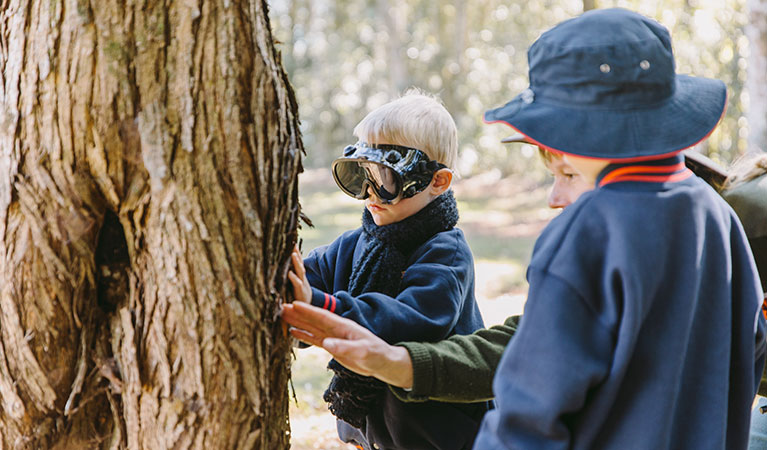
Sensing the Rainforest is a school excursion in Dorrigo National Park for Stage 3 (Years 5-6) students focusing on Geography outcomes. Ranger-guided activities encourage students to experience the rainforest through their senses, describing the diverse features and characteristics this Gondwanan rainforest environment.
Through guided, sensory activities such as silent sit spots, blindfolded games and nature observation, students become immersed in the rainforest. Differing perceptions about the management of places and environments are explored, through the lens of National Parks and Wildlife Management of this unique subtropical rainforest.
Students acquire and communicate geographical information using geographical tools for inquiry through map reading and interpretation and field observation.
This excursion is designed to support the Geography K-10 syllabus topic The Earth’s Environment.
For program outline, safety and practical information about this excursion, see info for teachers
| Stage | Stage 3 (Years 5-6) |
|---|---|
| Learning area | Geography |
| Student outcomes |
GE3-1. Describes the diverse features and characteristics of places and environments GE3-3. Compares and contrasts influences on the management of places and environments GE3-4. Acquires, processes and communicates geographical information using geographical tools for inquiry |
| Objectives |
Students will:
|
Excursion details
- Availability
- Guided. Available on request.
- Duration
- 2hrs
- Grading
- Easy
- Price
-
$260 per group (includes GST). Maximum 30 students per group. For groups over 30 conditions apply.
- Accessibility
- No wheelchair access
- Meeting point
- The Glade picnic area, 100 Lyrebird Lane
- Equipment
provided - Yes
- Booking
- If you would like to organise a NPWS school excursion please get in touch with local staff or use the 'Enquire' link for the online form.
Local alerts
For the latest updates on fires, closures and other alerts in this area, see https://www.nationalparks.nsw.gov.au/education/stage-3-geography-sensing-rainforest-dorrigo/local-alerts
Operated by
- School excursion inquiries - North Coast
- npws.northcoasteducation@environment.nsw.gov.au
Park info
- in Dorrigo National Park in the North Coast region
Dorrigo National Park is always open but may have to close at times due to poor weather or fire danger.
Info for teachers
All the practical information you need to know about Sensing the rainforest at Dorrigo National Park.
Program outline
- Meet at The Glade picnic area
- Welcome, acknowledgement of Country and safety briefing
- Interpretation by NPWS guide summarising the main natural and human impacts which put this ecosystem at risk
- Interpretation of rainforest features through various sensing games along the track
- Return to The Glade picnic area for lunch and bus pickup
- Farewell and depart
Getting there and parking
The Glade picnic area is in the western precinct of Dorrigo National Park. To get there:
From Armidale:
- Drive east along the Waterfall Way for approximately 90 minutes.
- Turn left into Dome Road approximately 2km after you pass through Dorrigo.
- Continue 2.6km along Dome Road, then along Lyrebird Lane to the end.
From Coffs Harbour:
- Travel south along the Pacific Highway.
- After crossing the Bellinger River, take the Waterfall Way exit to Dorrigo via Bellingen.
- Turn right at Dome Road and continue for approximately 2.6km along Dome Road, then along Lyrebird Lane to the end.
Road quality
- Sealed roads
Vehicle access
- 2WD vehicles
Weather restrictions
- All weather
Parking
Parking is available in a bitumen carpark at The Glade picnic area, at the end of Lyrebird Lane. It includes 2 accessible parking space, as well as coach and caravan parking.
What to bring
Please wear long pants, closed, comfortable shoes and bring a hat and sunscreen. Be ready for all weather conditions with a jumper and raincoat. Remember to bring extra food and water, and any necessary medications. Please bring your belongings in a backpack rather than a plastic bag.
Maps and downloads
Risk assessment and risk benefits
Our rangers and guides have the technical skill and experience to assess the risks and the benefits of a variety of activities delivered as part of our learning programs.
We believe in including opportunities that allow students to learn and experience for themselves through exploration in the natural environment.
Please make your own risk assessment based on the information provided. Detailed potential risks and controls are provided for the site to assist teachers in risk management planning. Teachers and carers should be aware of, and consider the needs, abilities and medical conditions of students when visiting this site. The supervision of students remains the responsibility of the teacher. The school must ensure an adequate number of adult supervisors are present.
Accessibility
Disability access level - no wheelchair access
Activity path includes a medium gradient timber ramp about 30 metres long, narrow sealed tracks with some uneven sections.